
THE BIG IDEA
Nothing like a click-bait article title is there?
(sorry)
But here’s the thing: I think it’s a reasonable question.
To be fair, though, I think I need to explain why.
The first part of my explanation is due to my recent research on influencing challenges for HR.
In reading the responses, my initial takeaway is that there’s nothing much new under the sun.
I’m reading about:
- Executives who don’t “get” HR
- Lack of time
- Lack of budget
- And on, and on, and on…
Sad to say, I’ve been hearing this my whole career in HR
(coming up on 30 years this December)
so color me unsurprised.
But that’s where the second factor kicks in.
You see, I was reading the early responses coming off the back of a bout of COVID-19
(thank you, vaccine)
and, frankly, was just too tired to try to play the silver linings game.
So, given that improving HR and HR people is, after all, the core of my business, the question had me troubled for most of December.
Here’s where I was churning. For me, there are few feelings worse than futility – that my/our precious time on this planet is wasted doing things that don’t count or that don’t grab the potential available.
As a result I’ve always taken barriers to transformation head on, whether at the personal, professional or organizational level. Needless to say, it wasn’t good for me to hear exactly what I was hearing in the mid-90s, exactly what I was hearing into the 2000s and… well, you get the drift. Familiar themes that I KNOW from experience aren’t set in stone.
Thankfully, December passed, as did the lingering low of COVID, and I’m now examining the question from a more balanced place.
Given that it seems many of my HR colleagues find it impossible to transform HR into something better because no-one seems to want it to happen, I come back to my original, thorny question:
Should HR exist?
First of all, let me ask: what was your immediate reaction to this article’s title?
You see, I never intended the title just to be click-bait – instead, I wanted to assess how it made you feel.
If you read it and were categorical that “It shouldn’t!” then we probably need to have a different conversation
(you may need to build an escape hatch, otherwise things can grow very toxic very quick)
But the majority of people reading this – so likely including you – aren’t going to respond that way, likely saying: “Of course HR should exist!”
Of that majority, there’ll be something of a continuum between “it’s an organizational requirement” and “it’s an essential transformative opportunity”.
Depending where you are between those poles, my guess is that you most likely felt some frustration or anger that I was asking the question, coupled with some level of “hater’s gonna hate”
(sadly, HR bashing has always been de rigeur, so we can build pretty thick scar tissue over time)
Regardless of intensity, your reaction is good news – because, if we don’t care whether HR exists, then how the hell else do we hope to influence for the better of people, teams and organizations?
(spoiler alert: I’m at the FAR end of the transformative opportunity! People, Teams, Organization and Culture are the only sources of competitive advantage)
If you’re still with me, and still have at least a glimmer of hope that things can be better, let’s dive in!
TRY THIS
So, we’ve answered the question. Should HR exist?
Yes.
And with that, we’ll end this article right here…
(Ha! Like I could ever write something that short!)
You see, it’s not nearly enough for us to answer the question for ourselves; we accomplish little by staying alone in our echo chamber.
Said differently, our opinion counts for nothing if we don’t go beyond our own answers.
So, let’s ask a different question.
For whom should HR exist?
Now we’re getting somewhere.
Because there’s a LONG list:
- Employees
- Applicants
- Leaders
- Shareholders
- Business Owners
- Minorities
- Legal
- Government Agencies
- Environment
- Social Shifts
I’m going to stop here, because the list can go on and on, depending on how inclusive you want to be in defining stakeholders.
So, let’s go back to a really simple construct:
Without a business
(organization, company… insert your entity of choice)
there would be no HR function. That means that the definition of HR falls squarely with the business.
Said differently, we can answer our follow-on question: HR exists FOR the business.
And, said differently yet again, on it’s own line, because it’s really, REALLY important…
The business gets the HR function it wants
(deserves?)
And, for those of us at the transformative end of the continuum, that’s a critical thing to know. Because, frankly, if they ain’t demanding the transformation, your best wishes count for very little at all.
Or, to go back to the research I’ve been conducting: if they don’t “get” it, but you believe you do, then helping them “get” it is JOB ONE.
And that all comes back to influencing, which I’ll be covering in much more depth as the weeks progress.
USE THIS
For now, let’s lay some ground-work for our influencing activity.
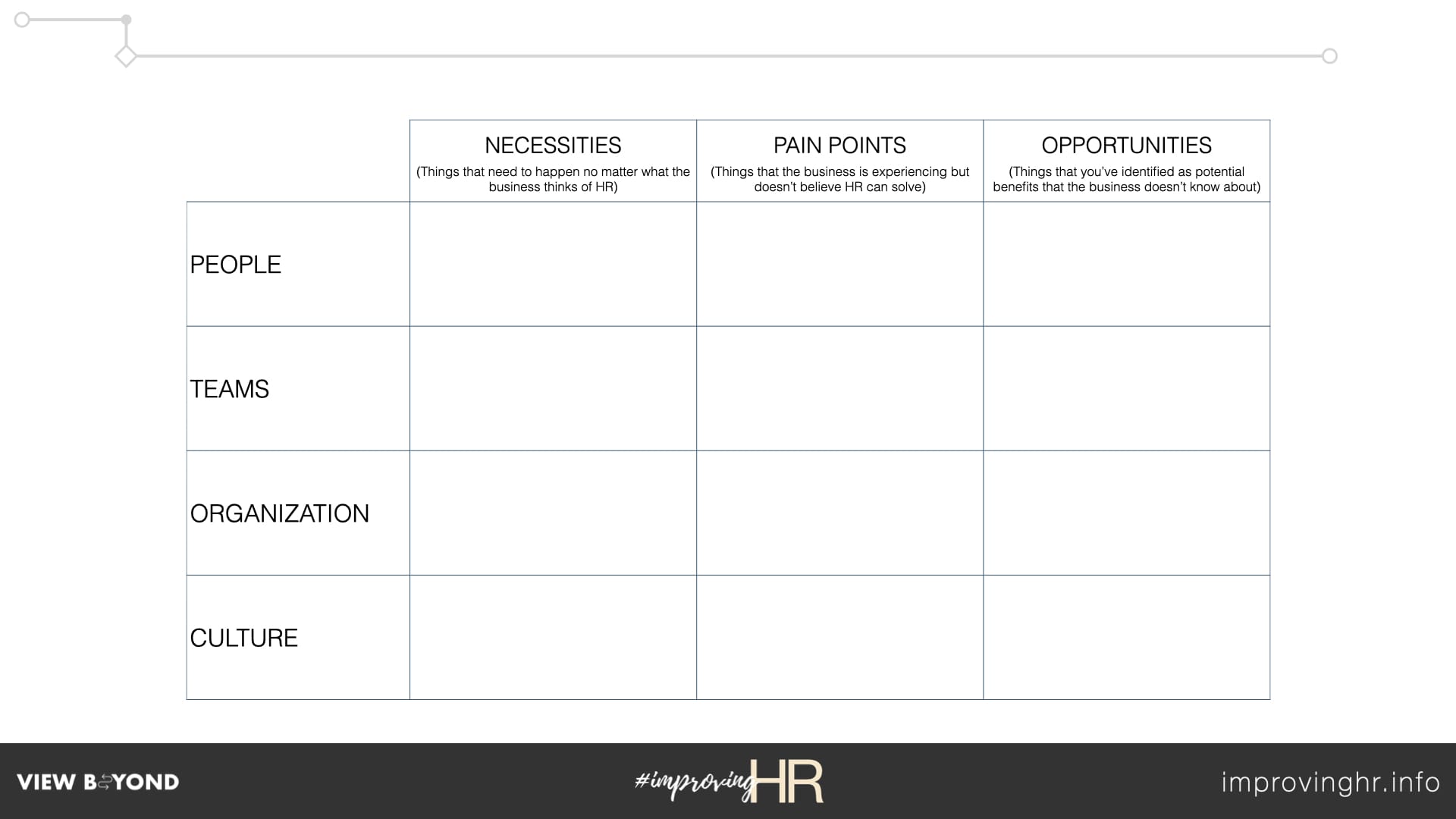
Here’s a quick tool to help you assess the landscape (click the image for a PDF). Think of it as all the assumptions you made when you answered my original question: Should HR exist?
FOOD FOR THOUGHT
“I’m looking for employees who have their own unique way of seeing things my way.”
~unknown
JOIN THE IMPROVING HR MASTERY COMMUNITY