

In the past couple of editions of Making Change Real, we’ve looked at the challenges of “I should…” and how to turn it into “I will…”.
Would that change were that easy, right? Truth is that even when we move past the shoulds to the wills, it can be really hard to make the change stick.
In today’s edition, I want to pull the camera back a little because the real power comes once you see how this works within the cycle of your change.
The Making Change Real cycle
Now, just by way of background, I have always been fascinated by a single question:
Why do people do what they do?
In fact, if there ever was somebody who should have studied Psychology, it was me! But sadly, in the times when I was at high school, the lack of focused career advice and socio-economics all conspired to not even highlight that as an option. I went a different route, but it was little surprise that I ended up spending most of the 20 years of my corporate life in HR focused on people and organization development
(in the 90s, I did over 5,000 in-depth selection interviews – talk about getting face-to-face with your core subject!)
and, after leaving, focused in on coaching as the main offering from View Beyond.
In the past sixteen years, I developed a language and metaphor for the coaching journey, which I described in full in The Way Through The Mountains, but underneath that is the synthesis of all those years learning about why people do what they do, everything about personal change and transformation, all boiled down into the Making Change Real cycle.
Here it is:
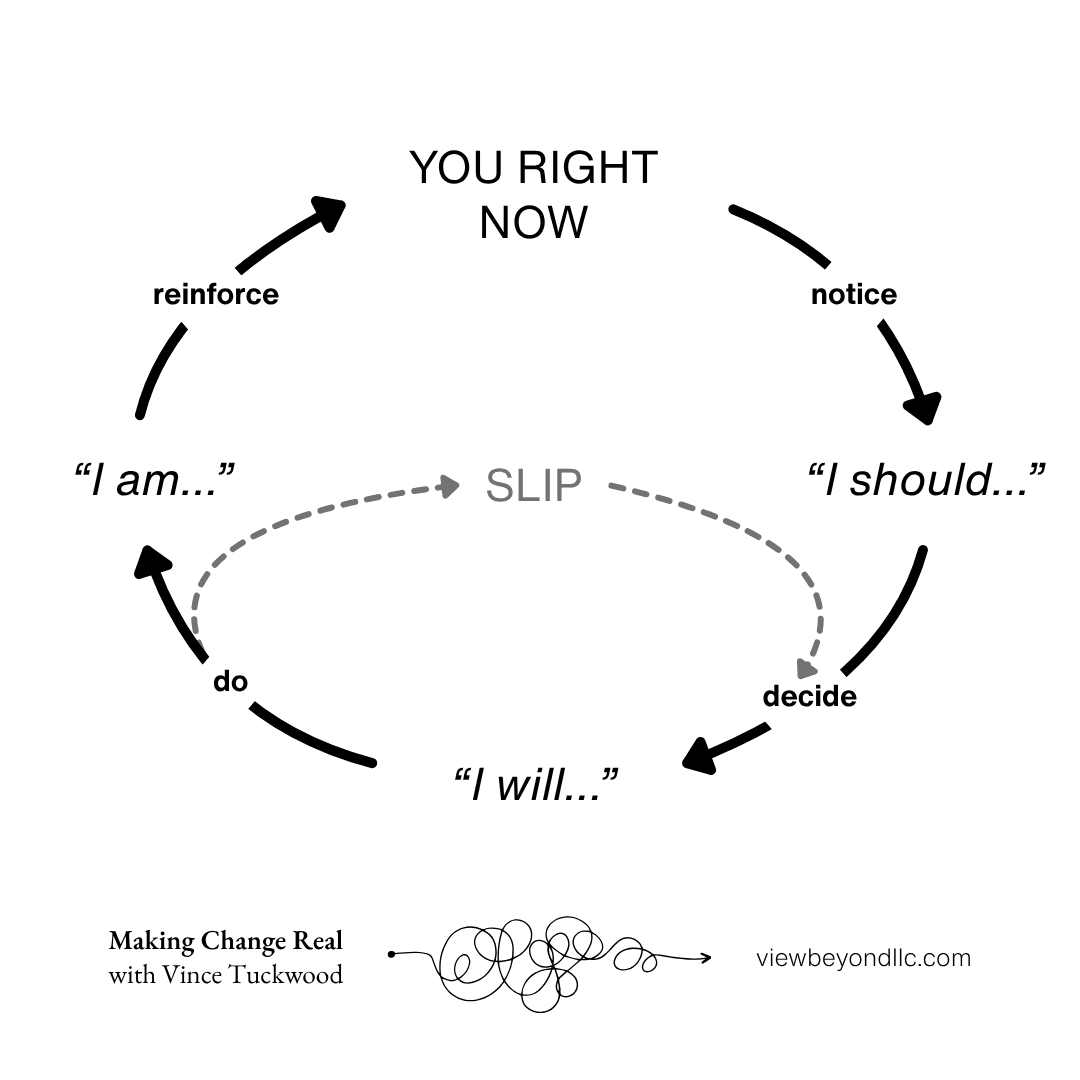
Pretty much every personal and professional change can be mapped onto this cycle
(and in a moment, we’re going to take a look at an example)
But put simply:
- You notice something you want to change about “You Right Now”, which makes you think “I should…”
- You decide that you are going to change, which becomes an “I will…”
- You do new things, and stop doing old things, enough that you evolve to “I am…”
- Which you reinforce through your day-to-day as “You Right Now”
Now, I don’t think this is rocket science but then, the simplest truths are often the most profound.
And what’s most important in this cycle isn’t so much the outer cycle, it’s that one in the middle where the doing breaks down and we SLIP. It happens to everyone, and it’s the primary cause of failure:
The SLIP becomes the STORY
We become someone who “can’t lose weight”, “can’t stop drinking”, “can’t get the promotion”, and on… and on…
What this cycle shows is that we simply need to revisit, reaffirm, or remake our DECISION and then DO the new things until we’ve done them enough to become our next self.
One final note on the cycle
The Making Change Real cycle also implies something that’s really, really important. Everything outside of that DO-SLIP-DECIDE cycle is in your head.
“I should…” is a CRITICAL PARENT voice.
“I am…” is a PERSONA-EGO-SELF identity.
“You Right Now” is a BEHAVIORAL CONSTRUCT.
These are abstract concepts which are almost impossible to shift directly. Said differently, your head is where change goes to die.
This is why, in the last edition, I called out the core truth of Making Change Real:
We DO change more than we THINK change
The Making Change Real cycle in action
Let’s take a look at a small example.
Jenny is worried that she will be laid-off in the relatively near future. Beyond that, her wider concern is that developments in AI are almost certain to make her current career opportunities shrink, or even disappear in the next few years.
As a fitness enthusiast, who helps out at her local exercise class, Jenny has often thought about starting her own personal training business. But every time she thinks about it, she gets scared about the financial hit and whether she could ever make enough money to pay the bills.
Jenny ends up reworking her resume and hoping that the worst case scenario doesn’t happen.
Let’s look at what just happened using the Making Change Real cycle, and how things could go differently.
Jenny has NOTICED a whole lot. She’s told herself “I should really have an alternative career path”.
But, immediately, she’s jumped to the “I am…” of having done it, and the fear that she won’t be enough
(one of two great human fears, second only to “will I lose love?”)
And, just like that, Jenny has thought herself out of making her change real.
What would the cycle tell her to do instead?
First, we all know that Jenny must turn her “I should…” into “I will…” – we looked at this in the last edition, and she could take any number of steps here, particularly chunking it down.
For me, whenever confronted with “that won’t work…” I encourage my clients to flip it over
(one of my favorite concepts in coaching for change)
to “how could I make it work?” – turning likely self-defeat into a spirit of exploration
(in essence, deciding to start The Way Through The Mountains)
For Jenny, my question would be:
“How would you train one person?”
and she would likely have a clear, clean answer, given that she knows the subject well.
So, the next question would be:
“Who might want to be trained that way?”
The answers here may not be so clear, but we’d be able to flesh out some ideas. Enough that we could then ask:
“How could you contact one of these people to discuss your approach?”
And that would be a doozy of a conversation, but we’d find the way!
Pause for a moment – see how much further we’ve come from Jenny’s initial knee-jerk rejection of her own idea?
Let’s go further.
We turn to a DECISION that Jenny will reach out to that one person to seek feedback on her ideas for personal training. We now have an “I will…”
Jenny will be reluctant, but I’ll coach her to do it anyway 🙂
And maybe the person will not respond, or they’ll respond with a “not interested”, or they’ll meet with Jenny and tell her “no way”, or they’ll provide feedback on why it won’t work, or they’ll…
And each time, Jenny will think she’s failing
(the SLIP)
but all we do is revisit the DECISION:
Which one person will I reach out to?
and use any feedback to inform how we’re thinking about the potential service.
Eventually one person will say “I’d love that!”
And the first customer will be in the books. This is how businesses form and grow in the real world.
We’ll leave Jenny’s story there for now, but hopefully I’ve shared enough to understand how the Making Change Real cycle goes beyond concept and abstraction. For me, it’s the rubric, framework, model and mindset to make it happen.
See you next month!

Quick question
 I’m thinking about adding a group call to discuss themes in the Making Change Real newsletter. These would fall in the week following publication, and be via Zoom, 30 minutes of presentation, 10-15 minutes of discussion. There would be a small charge to attend (likely $9 per month, waived for current coaching clients)
Would you be interested in joining me?


Making Change Real is a bi-weekly newsletter bringing together several previous publications: the longstanding blog at viewbeyondllc.com, the View Beyond newsletter on LinkedIn, and several other direct communications with View Beyond subscribers.
Everything I do revolves around making change real for people, helping them break free of where they’re stuck and become more of who they’re built to be.
Subscribe to Making Change Real, and receive a new edition direct in your inbox every other week.
NOTE: We use email addresses to follow-up with you and share information relating to associated products and services that may be of interest. We will not share your information with 3rd parties and will never spam you (all emails offer an easy unsubscribe option)